

Why seal expansion joints?
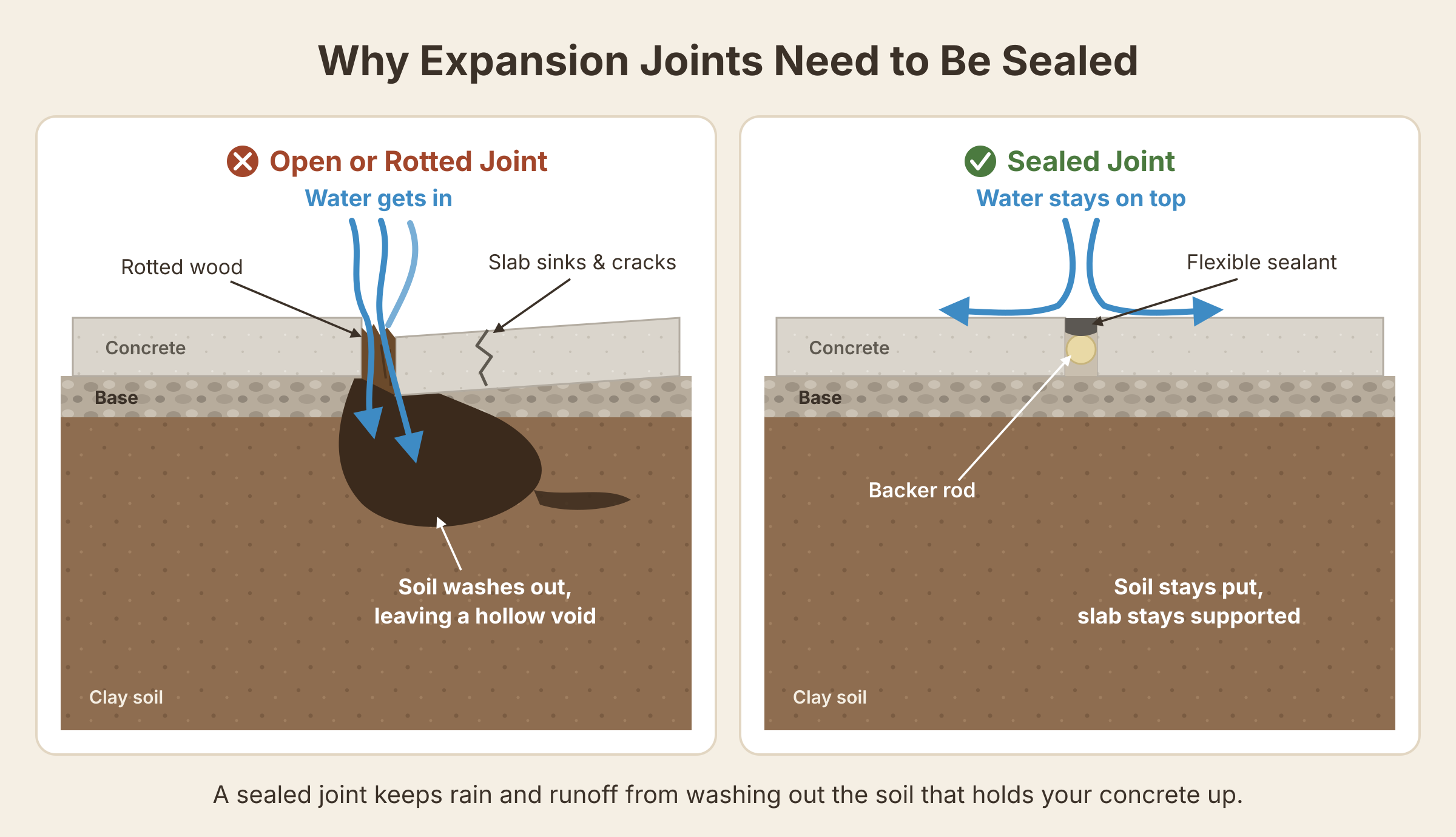
An open expansion joint isn't just an eyesore — it's a path for water to carry the ground right out from under your concrete. Here's what's actually happening under your driveway.
Expansion joints vs. control joints
An expansion joint is a real gap that separates two slabs so the concrete can expand, contract, and move a little without cracking. It's the joint that runs through your driveway or patio — the one that's supposed to stay sealed.
A control joint is different. It's a shallow cut the concrete crew tooled or sawed into a slab to tell the concrete where to crack. Control joints don't go all the way through — they just guide a crack to a spot where you won't notice it.
Central Texas soil, and why it matters here
Bell County sits right on the Balcones Fault, and the ground changes dramatically from one side of it to the other. That's the whole reason sealed joints matter so much here.
East of the fault — Temple & Troy
East of the fault — roughly east of I-35, including Temple — is the Blackland Prairie: dark, expansive clay that shrinks during our hot, dry summers and swells when it gets wet again. That shrinking leaves voids under slabs, and storms wash the loosened clay out through any open joint.
West of the fault — Killeen & the Hill Country
West of the fault — Killeen, Harker Heights, and the Hill Country side — the ground is limestone with thinner, rockier soils and more sloped lots. Runoff moves fast on those slopes, and it can wash base material right out from under the edge of a slab through an open joint.
Either way, the fix is the same: sealed joints keep water out from under the concrete. Rain and runoff have nowhere to travel, so the base under your slabs stays put — and your concrete doesn't sink, crack, or heave.
Common trouble spots
Water doesn't need much of an opening. These are the spots we see most often where runoff gets in under a slab:
- Downspouts draining near the edge of a slab
- Yards that slope toward the driveway or patio
- Flowerbeds and bare soil butting right up to concrete
What about freezing?
Water that freezes inside a crack can widen it a little more each winter. It happens here, but it's not the main cause of joint failure in Bell County — our bigger problem is heat, clay, and runoff. Sealing your joints handles both.